Engineering Personal Sovereignty
Your business isn't expensive to run. It's expensive to rent.
Building Your Digital Hard Drive: A Founder’s Command Center
The Fragmentation Tax (The Problem)
In the SAS framework, we optimized your internal operating system. Now, we must address your external hardware.
We have calibrated the Pilot (SAS) and established the need for a Unified Engine (LGH). Now, we execute the final step: Inner Calibration by taking a "Sovereignty Inventory."
The Problem: Most founders do not own their business intelligence infrastructure; they rent it. Their data, customer, product, and procedural information, is distributed across fragmented apps and "Cloud Dependencies."
This is a high-risk failure of Data Sovereignty. If a platform changes its API, one subscription fails, changes terms, or raises its "SaaS Tax," your "Frankenstein" breaks, the business "crashes, and your intelligence is inaccessible
The Solution: Engineering Your Asset Core
Stop leasing software and start engineering your Asset Core. This sequence introduces the clinical Sovereignty Audit.
The Digital Hard Drive as The Founders' Sovereign Audit
Building your Digital Hard Drive is the act of reclaiming your Digital Sovereignty. It is the transition from being a "User" to being a "System Administrator."
What is a Digital Hard Drive? It is not a physical object on your desk. It is a Unified Command Center, nd a decoupled repository, not just "another folder" on their desktop where your business intelligence lives.
It is the "Hard Drive" of your business engine, designed to be tool-agnostic. If you decide to change your project management software tomorrow, your business should not break because the data lives in your drive, not the software’s database.
The Blueprint: Implementing Your Command Center
To begin, you must mirror the exact architectural structure of the LGH engine. This ensures that every asset has a designated coordinate, eliminating the "guessing escapade" for you and any future team members.
The 4-Engine Folder Architecture
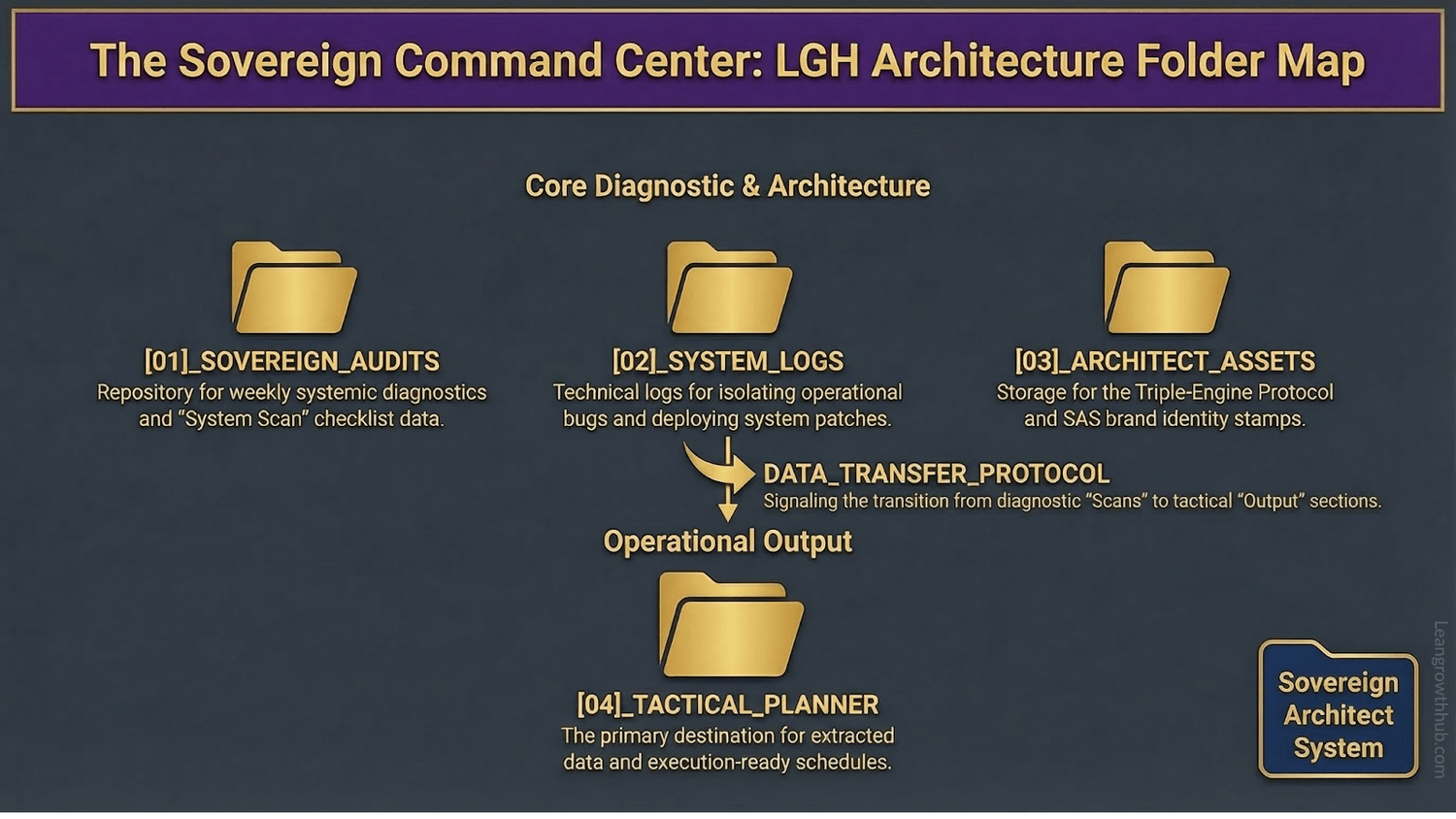
The 4-Engine Folder Architecture:
[01_CORE]: Manifestos, Values, and the Dual-Mission Context. This is the "Heart" of the build.
[02_OS]: Your Internal Calibration logs (The Journal) and Strategic Maps (SAS logic).
[03_ASSETS]: Every graphic, video, and text file you have ever produced.
[04_OPERATIONS]: The technical specs for your $0 Unified Business Engine and SOPs.
Solving the "Update" Doubt: The Sync vs. Storage Rule
A common concern when moving to a local-first Digital Hard Drive is:
"How do I handle updates?
Will my data become stale if it's not 'live' in an app?"
The Strategic Architect handles updates through Source-of-Truth Synchronization.
Apps are Windows, not Warehouses: You may still use Notion, Obsidian, or Trello to interact with your data, but those apps must point back to your Hard Drive.
The Versioning Protocol: When a process or asset is updated in an app, the final "Master" version is exported and saved back to the corresponding LGH folder (e.g., [04_OPERATIONS]).
Scheduled Maintenance: Updates are not reactive; they are systemic. During your Weekend Reset, you ensure that any "patches" made to your operating system during the week are reflected in your Digital Hard Drive. Your drive is the "Master Record"; the apps are merely the current "Work-in-Progress."
The Integration: Connecting SAS to LGH
The data you extracted during the Sequence: Mirror Diagnostic and the Sequence: System Log now has a physical destination. The "Subconscious Loops" you identified are documented and stored in [02_OS], and the "Technical Patches" you engineered to fix them are stored in [04_OPERATIONS].
Your internal clarity (SAS) is now backed up by technical infrastructure (LGH).
This is your "Business Hardware." Without it, you are building on quicksand.
By the end of this week, your task is to identify your "Top 10 Essential Assets", those files or Standard Operating Procedures (SOPs) your business cannot survive without, and move them out of a third-party app and into your own structured Digital Hard Drive following the map example above.
Systemic Implementation Protocol
This section provides the Sovereignty Checklist to guide you through the implementation protocol of your technical debt.
Audit the Source: List every app you use and the proprietary data it holds.
Audit the Ownership: Do you own the data (the master record) or are you a tenant?
Specify the Ten:: Identify the ten most critical procedural assets model (e.g., Product/Service Blueprint). This list becomes the technical requirement list that must be unified into a single Source of Truth.
Mirror this exact file structure (The Sovereign Command Center) on your local drive or private cloud (e.g., Proton Drive or a local SSD).
Sovereign Link: [Download the LGH Command Center Folder Template] (Link to a zip file or a high-res PDF of the map).
The Directive: Use this as the "Final Build" for Volume 01. You have identified the fractures (Sequence: Mirror Diagnostic 05), engineered the solution (Sequence: Venting vs Engine 06), and now you are installing the hardware (Sequence: Building Your Hard Drive 07)
The Bridge to Volume 02
The result of this audit is not just knowledge; it is a clinical requirement specification. Volume 02 moves from "Inner Calibration" to "Engine Construction".
Digital Sovereignty is not a luxury. It is the foundation of a $0 Unified Business Engine.

I founded the Lean Growth Hub to be more than just another tool site. It is an implementation of the Strategic Personal Architecture framework, a philosophy dedicated to helping 'Sustained Founders' build on lean, resilient foundations. Here, we don't just 'start businesses'; we engineer sovereignty.
Subscribe To Our Newsletter
Strategic Access:
The Blueprint Library
Building a sovereign business requires more than just tools; it requires a visual schematic. Explore our curated Pinterest boards to see the high-resolution architecture behind the Unified Engine.
THE SOVEREIGN MANIFESTO
We believe business should be an engine for freedom, not a source of technical anxiety. Build on rented land, and you are a tenant. Build your own architecture, and you are a Sovereign.
STRATEGIC DISCLOSURE
Disclosure: This site contains affiliate links; I may receive a commission at no cost to you. Success is based on strategic execution; results are not guaranteed.
© 2026 LeanGrowthHub